
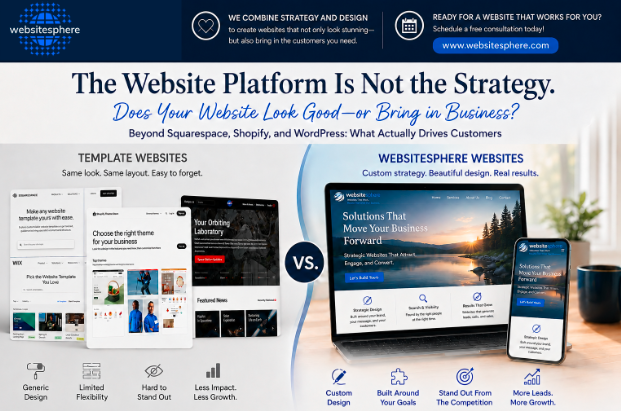
Templates may put a business online. Custom strategy helps the business stand out and gives visitors a reason to respond.
By Websitesphere | August 6, 2026
People often come to us after they have tried an “all-in-one” website platform. The promise sounded wonderful: choose a template, drag a few boxes around, add some photographs, and presto! your business is online.
And technically, it is online. But there is an important difference between having a website and having a website that helps build a business.
A platform gives you tools. It does not automatically give you positioning, persuasive messaging, search visibility, a customer journey, or a reason for someone to choose you. A hammer is useful too, but nobody has ever mistaken it for an architect.
FIXED AND RIGID TEMPLATES
Squarespace, Wix, and similar builders are popular for a good reason. They make it possible to create an attractive website quickly, even if “coding” sounds like something performed in a secret basement by people living on coffee.
For a simple personal site, event page, or early business idea, that convenience can be exactly what is needed. The templates are polished, hosting is included, and the editing tools are usually friendly.
Need more than a template? Let’s build a website designed around your customers and business goals.
The problem is not that templates are ugly. Many are lovely. The problem is that “lovely” and “effective” are not synonyms.
SUBSCRIPTIONS AND FEES EVERY MONTH
Shopify is a strong e-commerce platform. It handles products, payments, inventory, shipping, and many of the moving parts that can make an online store owner consider hiding under the desk.
But Shopify is still the foundation—not the complete business strategy. A store needs more than product pages and a checkout button. Customers need to understand why the product matters, trust the company, find what they want, and feel confident completing the purchase.
Shopify can run the store beautifully. It still needs strategy, branding, content, search visibility, and ongoing marketing to bring people through the door.
OUTDATED SOFTWARE
WordPress offers tremendous flexibility. It can support a small professional website, a large publishing platform, a membership community, or a highly customized business solution. If the other platforms provide a furnished apartment, WordPress gives you the keys, the floor plan, and permission to move the walls.
That freedom is powerful—but it also comes with responsibility. WordPress needs thoughtful architecture, secure hosting, carefully selected plugins, regular updates, backups, performance management, and someone who knows what to do when two plugins suddenly decide they are no longer speaking to each other.
WordPress is capable of delivering a truly custom solution. The value comes from how it is planned, designed, built, maintained, and connected to the larger marketing strategy.
At Websitesphere, we do not begin by asking, “Which template should we use?” We begin with better questions: Who are your customers? What are they trying to accomplish? Why should they trust you? What action should they take? And how will we know the website is working?
Then we select and shape the technology around the business—not the other way around.
That may mean Shopify for a serious online store, WordPress for a flexible content and lead-generation platform, or another solution that fits the real requirements. The platform matters, but it is only one part of the job.
A beautiful website should do more than sit online looking attractive. It should help the right people find your business, understand what you offer, and feel confident enough to contact you.
That is where strategy makes the difference. We combine thoughtful design with search visibility, clear messaging, strong calls to action, and ongoing performance tracking. The goal is not simply to produce more website traffic. It is to turn that traffic into genuine inquiries, leads, and customers.
The outcome that matters: more qualified visitors, more genuine inquiries, and more opportunities to build customer relationships.
More visitors. More leads. More customers.
Because the real measure of a successful website is not how many compliments it receives. It is whether it helps your business grow. After all, “Your website looks beautiful!” is lovely to hear—but “We found you online and would like to hire you” sounds even better.
Squarespace, Shopify, and WordPress are tools. Each can be useful. None of them is a substitute for understanding your customers and building a deliberate path from first visit to real business relationship.
If your current website looks respectable but rarely produces calls, forms, appointments, or sales, the answer may not be another template. It may be a clearer strategy.

www.websitesphere.com


Get The Latest Update
By subscribing, you're accept Privacy Policy | Terms and Condition | Refund Policy